
In a turn of events, India on Friday said it was "hopeful" talks for a global deal on easing Customs norms, or a trade facilitation agreement (TFA), would be revived in September, even as it failed to meet the July 31 deadline due to lack of consensus among members over food stockholding and farm subsidies.

The canteens would come up in and around industrial areas, hospitals, educational institutions and commercial hubs.

Irrigation woes have contributed to the problem of stubble burning in the state, reports Sarthak Choudhury.

'You want poor people who take 5 kg rice to produce an Aadhaar card.' 'The poor man may or may not have Aadhaar.' 'Poor people are losing their food and dying.'

Maharashtra Chief Minister Eknath Shinde on Wednesday said Memorandums of Understanding worth Rs 1.37 lakh crore have been signed at the World Economic Forum (WEF) annual meeting in Davos in Switzerland and termed it as a "big achievement". This will generate employment for one lakh people, said Shinde, who was in Davos to seek investments in Maharashtra. "The MoUs will not remain just on paper," he said, adding that foreign investors have shown trust and faith in the state government.

India's overall retail inflation eased to 4.41 per cent in September, helped by falling commodity prices, but rural inflation was at 5.05 per cent

As hard bargains continue for the next four days at the picturesque tourist resort of Indonesia, the ministers., including from the influential developed countries will try and reach agreements on providing windows to the developing nations for their food security programmes and a pact to free the global trade from the procedural hassles at the customs.

Prime Minister Narandra Modi on Saturday said the government "chose" to take a tough stand in the recent WTO talks as it has to protect the interest of the poor people of the country rather than to look for good publicity in the international media.
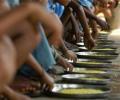
Nowhere on the planet, nowhere in mankind's history has such an idea taken the concrete shape in form of a law. The National Food Security Bill, which will come via ordinance and not after the debate in Parliament, is an incredible economic tool to tackle the hunger of poor Indians. Also, it has already been condemned widely as a political gimmick.

Pre-Budget excercise next month should scrupulously avoid adventurism of all types and refrain from making excessively ambitious projections on revenue and expenditure numbers for 2023-24, suggests A K Bhattacharya.
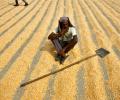
India is in no danger of crossing the 10 per cent threshold of food subsidies under the WTO's agreement on agriculture and it will not breach the level in the near future.
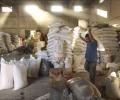
There are about 500,000 fair price shops in states and UTs combined.
The deficit stood over Rs 8 trillion in the first seven months of the current financial year. Non-tax revenues, comprising transfers from the RBI and dividends of the public sector units, shored up the Centre's revenues.
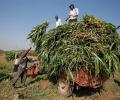
Lauding the farm sector for demonstrating resilience during the pandemic, the Economic Survey on Friday suggested the government to see farm sector as a "modern business enterprise" for which "urgent reforms" are required to enable sustainable and consistent growth. India's agricultural sector has shown its resilience amid the adversities of COVID-19 induced lockdowns, the Survey noted. The agriculture and allied activities were the sole bright spot amid the slide in GDP performance of other sectors, clocking a growth rate of 3.4 per cent at constant prices during 2020-21, it added. According to the Survey, the farm sector has got "renewed thrust" due to various measures on credit, market reforms and food processing under the Aatmanirbhar Bharat announcements.

Only 80.6 per cent of the Rs 6-trillion allocation has been spent by February, data from the Controller General of Accounts shows.

India and other developing nations, on the other hand, want the peace clause until a permanent solution is found on the matter for smooth implementation of the food security programme.

The immediate need is to put more money in the hands of agriculture-based and rural households to improve their purchasing power, says S Mahendra Dev.
Excise duty hike for cigarettes could be lower.
This is the Centre's highest-ever budgeted capital outlay.

'Transparency is us watching the government and not the government watching us'

While India won't be immune to global spillovers, we need to create the macro preconditions for sustained growth. Policy agility, prudence, and resilience will be key, suggests Sonal Varma.

The proposed National Food Security Act (NFSA) may have to be put off to 2012 due to financial constraints, going by a recent Planning Commission document which points out that additional resources of Rs 77,000 crore will be required to implement the programme.

Why did Karnataka's economic prosperity fail to influence the nature of electoral promises made by political parties in the run-up to the assembly elections? asks A K Bhattacharya.

Showing signs of financial strain, the government's fiscal deficit in the first five months of the ongoing financial year has already touched 74.6 per cent of the budget estimate.

Growth is going to be an important factor in contributing high tax revenue and in containing the fiscal deficit.

'I remain optimistic that 2021 will be better than 2020 because we have visibility of vaccinations this year.'

The much-touted Food Security Bill was taken up in Rajya Sabha, with opposition terming it as a "gimmick" with an eye on elections and accusing government of violating constitutional norms by issuing an ordinance when Parliament session was less than a month away.

India has put curbs on wheat exports through the government route, starting November last year. This comes amid a surge in domestic prices of the cereal. In December, India exported 391 tonnes of wheat to Bangladesh and Bhutan. In November 2022, it had exported 375 tonnes of wheat only to Bhutan.

Enhanced revenue generation is a priority for the government.

Finance Minister Nirmala Sitharaman on Thursday announced a Rs 11.11 lakh crore spending on infrastructure and vowed to continue reforms as she resisted resorting to populist measures in Modi government's last Budget before general elections, instead choosing to stay on the path of cutting deficit while bolstering measures for focus groups.

China, Indonesia ready to agree to a four-year interim solution.

WTO's new director has said that the issue needs to be addressed in a positive manner.

Prime Minister Narendra Modi on Saturday announced the adoption of the New Delhi Leaders Declaration, a significant victory for India's G20 presidency that came amid increasing tensions and divergent views over the Ukraine conflict.

Budget for 2022-2023 has returned to its agenda for protectionism in the name of creating a self-reliant India, points out A K Bhattacharya.

'I'm pitching India for the strengths we offer, including the English language, engineers, doctors, nurses, professionals, innovative talent of startups.'

India's Food Security Act entitles 82 crore people to 5 kg of foodgrains per person a month at Rs 1-3 per kg.
More important is to diversify the country's farm production base.

Restoration of the pre-2004 pension scheme, regularisation of contract employees after two years, enhanced daily wages, social security pension and appointment of anti-corruption grievances commissioner were the other promises made in the manifesto.
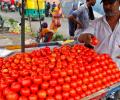
8 out of 10 households are planning to cut their tomato consumption if prices stay in the Rs 75-150 kg range over the next three months.

The obvious temptation for Mr Jaitley would be to achieve a better fiscal deficit figure than what he had promised in July.
